Every material responds differently when exposed to heat. Some materials absorb moisture from the environment and lose weight during heating, while others undergo melting, crystallisation, oxidation, decomposition, or remain thermally stable over a wide temperature range. Understanding these thermal behaviours is essential for selecting suitable materials, improving manufacturing processes, ensuring product quality, and investigating material failures.
One of the most comprehensive techniques for studying these thermal properties is Simultaneous Thermogravimetric Analysis and Differential Scanning Calorimetry (TGA-DSC). As its name suggests, TGA-DSC combines two complementary analytical techniques into a single experiment, allowing researchers to monitor both mass change and heat flow simultaneously as a material is heated under controlled conditions.
By measuring these two parameters at the same time, TGA-DSC provides a more complete picture of how a material behaves with increasing temperature. Correlating weight changes with thermal events enables researchers to distinguish between physical transitions and chemical reactions, making the interpretation of results more reliable than when either technique is used independently.
For example, a reduction in sample mass accompanied by an endothermic signal often indicates the evaporation of moisture or volatile compounds. A melting process typically appears as an endothermic peak without any corresponding mass loss, while oxidation or combustion may produce both changes in weight and exothermic heat flow. Observing these events simultaneously provides valuable insights into the mechanisms occurring within the material.
Different Materials Behave Differently
One of the most important aspects of TGA-DSC analysis is recognising that each material possesses its own unique thermal behaviour. The thermal profile obtained depends on factors such as chemical composition, molecular structure, crystallinity, purity, processing history, and the surrounding atmosphere during testing.
Consequently, not all materials exhibit DSC peaks. Semi-crystalline polymers often produce distinct melting and crystallisation peaks, whereas amorphous polymers may only exhibit a glass transition without any melting peak. Some inorganic materials, ceramics, metals, or mineral-based samples may remain thermally stable throughout the selected temperature range and therefore display little or no detectable DSC transitions.
Likewise, not every material experiences a measurable weight change. Certain samples may show significant heat flow without any loss of mass, while others may undergo substantial decomposition with only minor thermal transitions.
Therefore, the absence of a melting peak, crystallisation peak, or other DSC signal does not indicate that the analysis was unsuccessful. Instead, it reflects the inherent thermal characteristics of the material under the selected experimental conditions. The results obtained are influenced by several experimental parameters, including the temperature range, heating rate, sample mass, crucible type, and testing atmosphere.
What Information Can Be Obtained?
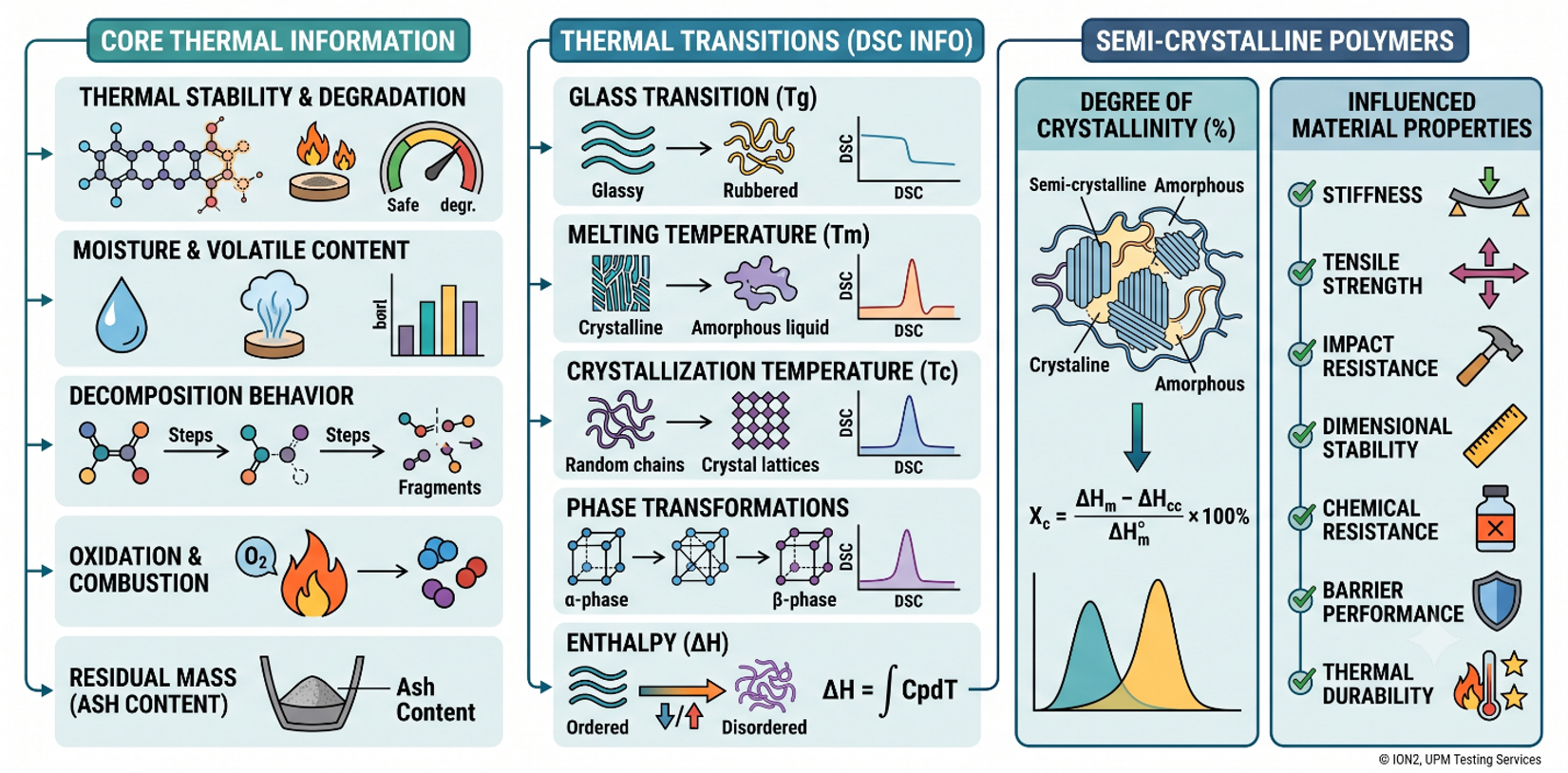
Depending on the nature of the material, TGA-DSC analysis can provide a wide range of thermal information, including:
- Thermal stability and degradation temperature
- Moisture and volatile content
- Thermal decomposition behaviour
- Oxidation and combustion characteristics
- Residual mass (ash content)
- Glass transition temperature (Tg)
- Melting temperature (Tm)
- Crystallisation temperature (Tc)
- Phase transformations
- Heat absorbed or released during thermal events (enthalpy)
- Reaction kinetics for selected thermal processes
- Estimation of material composition based on thermal behaviour
For semi-crystalline polymers, DSC data can also be used to determine the degree of crystallinity (%). This parameter is calculated from the measured enthalpy of fusion by comparing it with the theoretical heat of fusion of a fully crystalline material.
The degree of crystallinity is an important material property because it influences stiffness, tensile strength, impact resistance, dimensional stability, chemical resistance, barrier performance, and thermal durability. It is widely used to evaluate processing conditions, compare raw materials, optimise manufacturing parameters, and assess the effects of ageing or recycling on polymer performance.
The Importance of the Testing Atmosphere
The surrounding atmosphere during thermal analysis plays a significant role in determining the thermal behaviour of a material. Different gases can promote or suppress specific reactions, making the selection of an appropriate atmosphere essential for obtaining meaningful results.
An inert atmosphere, commonly nitrogen, is used to prevent oxidation and allows researchers to study the intrinsic thermal stability and decomposition behaviour of a material. In contrast, oxygen or compressed air promotes oxidative reactions, enabling the investigation of oxidation resistance, combustion behaviour, thermal ageing, and oxidation onset temperatures.
Careful selection of the testing atmosphere ensures that the experimental conditions closely represent the material's intended service environment or processing conditions.
Applications for TGA-DSC
Because of its versatility, TGA-DSC is widely applied in research, development, manufacturing, and quality assurance across many scientific and industrial sectors. Typical applications include:
- Polymer and plastic characterisation
- Nanomaterials and nanocomposites
- Electronic and semiconductor materials
- Pharmaceutical products
- Biomaterials
- Food and packaging materials
- Ceramics and refractory materials
- Catalysts
- Battery and energy storage materials
- Metals, alloys, and minerals
Researchers frequently use TGA-DSC to compare materials from different suppliers, investigate product failures, evaluate recycled materials, determine filler or ash content, study curing reactions, assess thermal ageing, optimise processing conditions, and monitor product consistency during manufacturing.
The Limitations of Simultaneous Analysis
While combining TGA and DSC into a single experiment provides powerful correlative data, it inherently involves certain experimental compromises compared to using dedicated, standalone instruments. Understanding these limitations is critical for accurate data interpretation:
- The Sensitivity Compromise: Simultaneous TGA-DSC instruments (often referred to as STA, or Simultaneous Thermal Analysis) require a larger furnace and sensor assembly to accommodate internal microbalance. This higher thermal mass makes the instrument slightly less sensitive to weak heat flow signals than a standalone DSC. As a result, subtle thermal events, most notably the Glass Transition Temperature (Tg) of amorphous polymers, can be difficult to detect and may require secondary testing on a dedicated instrument.
- The Crucible Dilemma: Simultaneous analysis restricts how a sample can be prepared. To accurately measure mass loss (the TGA portion), the sample crucible must be open to the atmosphere or have a pierced lid to allow evolved gases to escape. However, pure DSC testing often utilizes hermetically sealed (airtight) pans to suppress the evaporation of moisture or volatiles.
- The Buoyancy Effect: As the furnace heats up, the density of the purge gas inside it naturally decreases. This change in atmospheric density causes an apparent, artificial weight gain in the sample known as the buoyancy effect. To obtain highly accurate TGA data, operators must run an empty crucible "blank" under identical heating conditions and digitally subtract it from the final sample data to correct for this phenomenon.
Reliable Thermal Characterisation
Obtaining meaningful thermal analysis data requires more than simply heating a sample. Appropriate selection of experimental parameters, including sample mass, heating rate, temperature range, crucible type, and testing atmosphere, is essential to ensure accurate and reproducible results. Interpretation of the data also requires an understanding of the material being analysed and the objectives of the investigation.
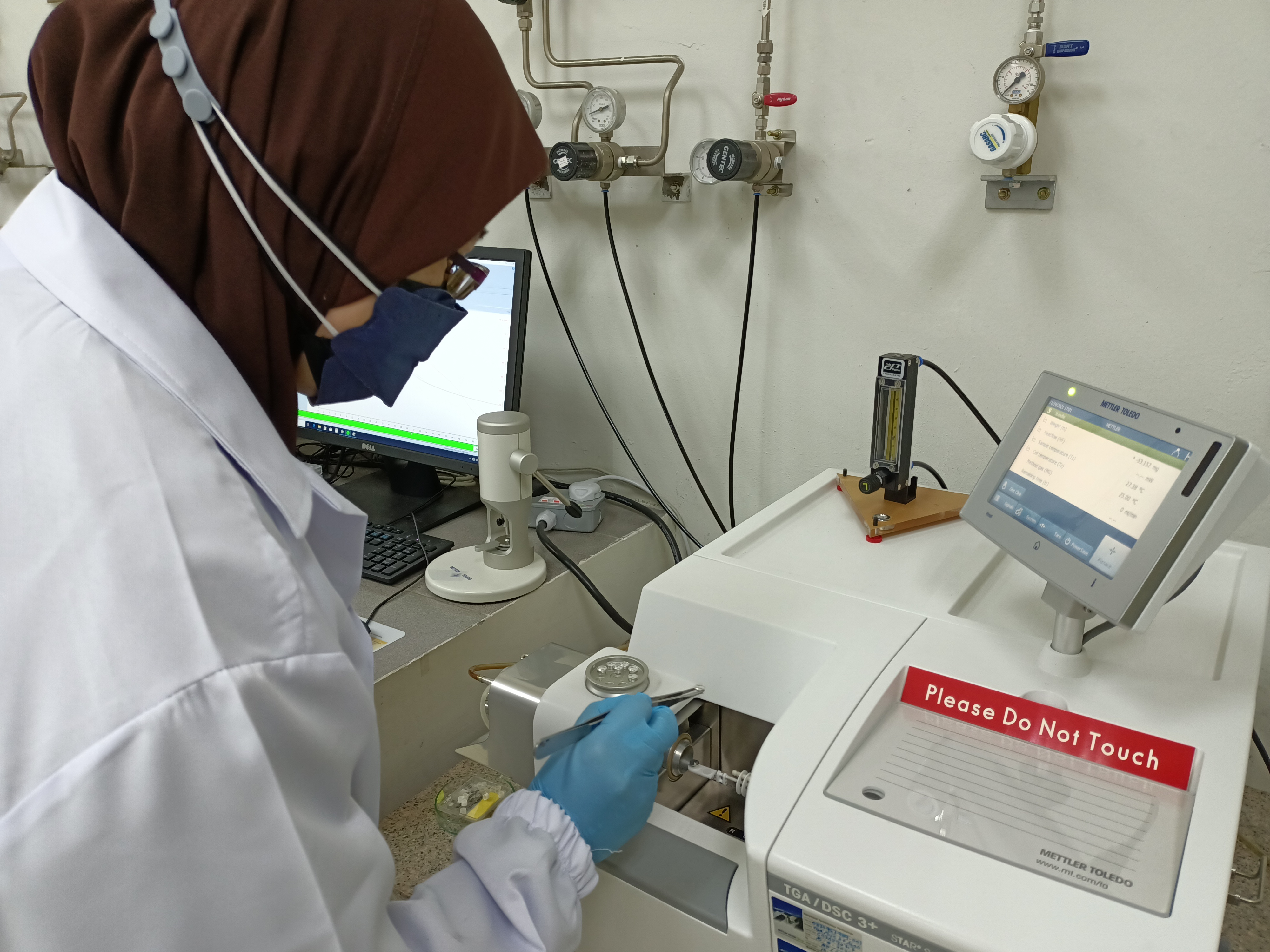
At the Institute of Nanoscience and Nanotechnology (ION2), Universiti Putra Malaysia, TGA-DSC analysis is performed using the METTLER TOLEDO TGA/DSC HT 3 simultaneous thermal analyser. While the instrument is capable of operating at temperatures up to 1,600°C, routine analyses are limited to 1,400°C to maintain long-term instrument performance and ensure measurement reliability. The system supports programmable heating profiles and interchangeable gas atmospheres, including nitrogen (Nâ‚‚), oxygen (Oâ‚‚), and compressed air, enabling comprehensive thermal characterisation for a wide range of materials.
For further information regarding TGA-DSC analysis or testing services, please contact ion2_services@upm.edu.my.
By,
Roslina Abdul Rashid
Tarikh Input: 18/08/2026 | Kemaskini: 18/08/2026 | roslina_ar
PERKONGSIAN MEDIA