Why does your phone get so hot?
You have probably noticed it yourself. After watching a few videos or playing a game for a while, your smartphone starts to feel warm. Most of us assume it is just the processor working hard or the battery draining. But the real reason is something you cannot see. It is electromagnetic noise.
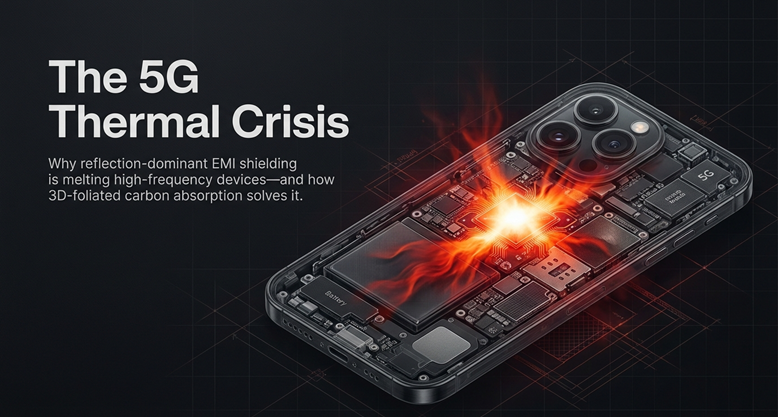
Inside your phone, data moves at incredible speeds. All that activity creates electromagnetic radiation. If this energy is not controlled, it interferes with other components. It messes with your signal. It generates heat. And eventually, your phone has to slow itself down just to keep from overheating.
For years, phone makers had a simple way to deal with this. They lined the inside of devices with metal. Silver, copper and nickel pastes were applied to parts that needed protection. These metals acted like mirrors. They bounced the electromagnetic waves away. Problem solved.
The move to 5G and the upcoming 6G networks has created a challenge that engineers did not see coming. These networks use much higher frequencies to deliver faster data. But inside the tight space of a modern smartphone, these high frequency waves behave differently.
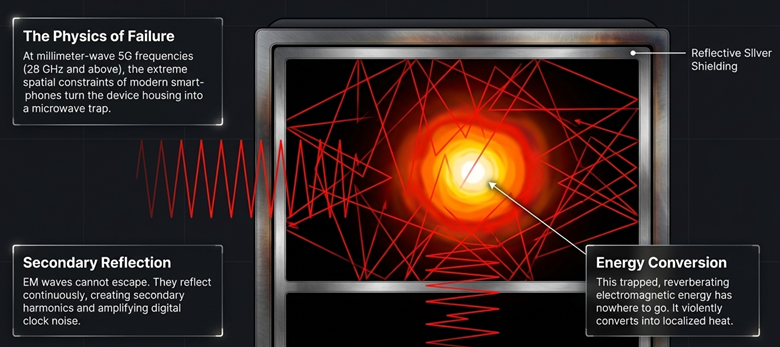
Metal shielding works well at lower frequencies. But at 5G frequencies, it becomes a problem. It still reflects the energy like a mirror. But inside a cramped phone, that energy has nowhere to go. It bounces around inside the device. Engineers call this the reverberant cavity effect.
Think of it like shouting in a small empty room. The sound does not disappear. It echoes off the walls and creates distortion. The same thing happens to 5G signals. The reflections create interference between components. They corrupt data and confuse the phone's receivers. And all that trapped energy turns into heat. Your phone gets hot not because it is working hard, but because it is fighting its own reflections.
There is another issue too. Silver based pastes are expensive. Metals are heavy and you need a lot of them. Sometimes 80 percent of the shielding material is just metal filler. This adds bulk to phones that are already packed tight. Over time, these metals corrode. In humid conditions, silver particles can even move around and create short circuits.
For Malaysia, this is a serious problem. The country handles about 13 percent of the world's semiconductor assembly. But it relies entirely on imported silver pastes. Prices swing wildly between RM 36,000 and RM 45,000 per kilogram. That is a massive economic weakness.
A team at Universiti Putra Malaysia's Institute of Nanoscience and Nanotechnology thinks they have found a better way. Instead of building a better mirror, they built a sponge. The material they developed is called a grapheneated carbon nanotube silicone adhesive. The name sounds complicated, but the idea is simple. Imagine a carbon nanotube. It is a hollow cylinder, stronger than steel and thinner than a strand of hair. Now picture tiny flower like petals of graphene growing all over its surface. What you get looks like a microscopic sea urchin. Fluffy and three dimensional.
This shape is what makes it work like a sponge. When electromagnetic waves hit this material, they do not bounce off. They go inside and get lost. The thousands of tiny spaces between the nanotube core and the graphene petals give the waves plenty of places to interact. Through a process called interfacial polarization, the electromagnetic energy turns into tiny amounts of heat that disappear almost instantly.
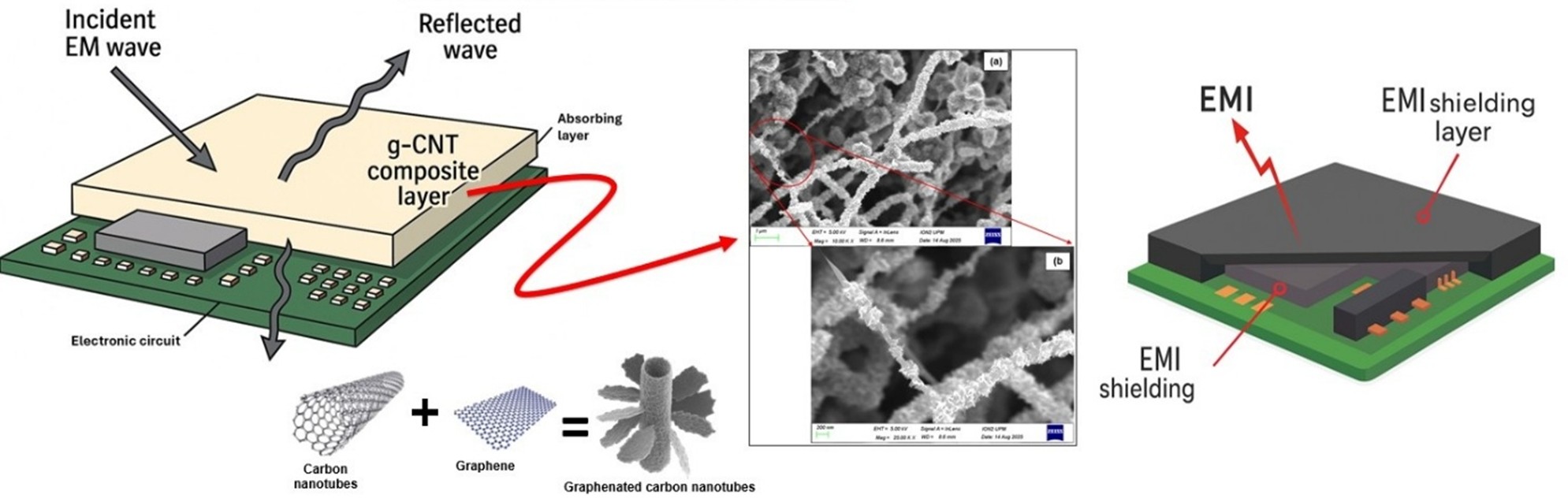
The difference is huge. A metal mirror reflects about 99 percent of the energy, which then bounces around inside your phone. The g-CNT sponge absorbs more than 99.99 percent of it. Lab tests show that with only 30 percent filler loading, it blocks over 99.999 percent of electromagnetic radiation. And it does this by absorbing, not reflecting. It is designed as a direct replacement for the silver pastes that factories already use. It flows smoothly through the tiny nozzles of robotic dispensing machines without clogging. That is important for high volume production.
For the average person, this means better phones. Imagine a device that stays cool even during long gaming sessions. A phone that holds a strong 5G connection without dropping calls. A device that runs fast all the time because it never has to slow down to manage heat.
This technology also means Malaysia can produce its own advanced materials instead of buying expensive imports. It replaces mined silver with a carbon-based solution that is better for the environment. And it proves that world class innovation can happen right here. Your phone gets hot because it is fighting a war you cannot see. But with this Malaysian innovation, that fight might soon be over.
Written by:
Dr. Ismayadi Ismail
Research Officer, NSCL
Date of Input: 16/03/2026 | Updated: 16/03/2026 | roslina_ar
MEDIA SHARING