Raman spectroscopy is a versatile and non-destructive technique widely used in materials science to probe molecular vibrations, chemical structures, and crystallinity. Beyond its conventional applications, researchers can further enhance data quality and broaden the scope of their studies by incorporating complementary approaches—most notably polarization control or surface-enhanced Raman spectroscopy (SERS). The choice between these techniques ultimately depends on the specific research objectives.
Polarization-dependent Raman spectroscopy employs polarizers to analyse how the intensity of Raman scattering varies with the orientation of incident and scattered light. This technique is particularly powerful for materials where molecular alignment or crystallographic orientation is critical. For example, in polymers, polarization analysis can reveal chain orientation and degree of crystallinity, while in semiconductors, it can be used to study stress, strain, and anisotropy. In contrast, isotropic materials such as liquids or highly symmetric molecules (e.g., cyclohexane) exhibit little to no dependence on polarization, as their molecular vibrations are averaged in all directions. Anisotropic materials, however, show strong polarization dependence, where specific vibrational modes vary in intensity with orientation. The data obtained therefore provide unique structural and orientation information that cannot be captured by standard Raman measurements, making polarization an excellent option when the goal is to understand order, symmetry, or directional properties in a material.

Figure 1: Polarized Raman spectra of isotropic cyclohexane recorded under different polarization configurations. The overlaid normalized spectra illustrate the absence of polarization dependence in isotropic samples, consistent with the molecular symmetry of cyclohexane.

Figure 2. Morphology and polarization Raman analysis of twisted graphene nanoribbons. (a) The topographic STM image (b) A zoom-in topographic image clearly shows the presence of multiple heterostructures. (c) Polarized Raman spectrum of twisted graphene nanoribbons.
By contrast, surface-enhanced Raman spectroscopy (SERS) focuses on boosting signal intensity. When analytes are adsorbed onto nanostructured metallic substrates—commonly silver or gold—the local electromagnetic field amplifies Raman scattering by several orders of magnitude. This enhancement enables the detection of extremely low concentrations, down to the single-molecule level in some cases. For instance, SERS is ideal for identifying trace contaminants in water, detecting microplastics, or sensing biomolecules such as proteins or DNA fragments. The type of data obtained through SERS is not primarily about orientation or crystallinity, but about achieving ultra-sensitive detection of species that might otherwise remain undetectable.
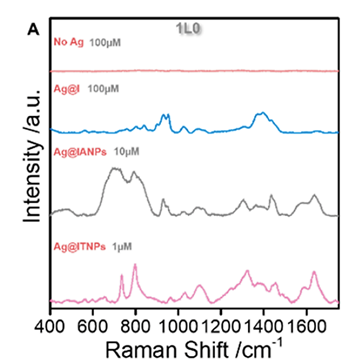
Figure 3: SERS spectra of RNA in water with different type of silver (Ag) nanoparticle.
To help researchers decide which approach better aligns with their objectives, the following table summarizes the key differences:
| Feature / Objective |
Polarization Analysis |
Surface-Enhanced Raman Spectroscopy (SERS)
|
|
Main Purpose
|
Study molecular orientation, crystallinity, and symmetry
|
Enhance Raman signal intensity for ultra-sensitive detection
|
|
Type of Data Obtained
|
Structural order, chain alignment, stress/strain, anisotropy
|
Presence/identity of low-abundance analytes at very low concentrations.
|
|
Best Suited For
|
Polymers, crystalline solids, thin films, semiconductors
|
Environmental pollutants, microplastics, biomolecules, trace chemicals
|
|
Key Advantage
|
Reveals structural/anisotropic properties not visible in standard Raman
|
Detects analytes down to ppm–ppb or even single-molecule levels
|
|
Example Application
|
Determining polymer chain orientation in a stretched film
|
Detecting pesticide residues in water at sub-ppm levels
|
In summary, researchers should select polarization analysis if their objective is to extract detailed structural and orientation information, while SERS should be the method of choice when ultra-sensitive detection is required. Both approaches, when integrated deliberately into Raman workflows, can transform routine measurements into deeper insights and open new avenues of discovery in materials science.
Further references:
- Polarized Raman spectroscopy strategy for molecular orientation of polymeric fibers with Raman tensors deviating from the molecular frame, Svenningsson, L., & Nordstierna, L. (2020), ACS Applied Polymer Materials.
- 3D orientation imaging of polymer chains with polarization-controlled coherent Raman microscopy, Xu, S., & Lee, Y. J. (2022), Journal of the American Chemical Society.
- Polarized Raman Spectroscopy for Determining Crystallographic Orientation of Low-Dimensional Materials, Bo Xu, Nannan Mao, Yan Zhao, Lianming Tong & Jin Zhang (2021), The Journal of Physical Chemistry Letters.
- Development and application of surface-enhanced Raman scattering (SERS), Huang, Z., Peng, J., Xu, L., & Liu, P. (2024), Nanomaterials.
- Towards practical and sustainable SERS: a review of recent developments in the construction of multifunctional enhancing substrates, Li, C., Huang, Y., Li, X., Zhang, Y., Chen, Q., Ye, Z., et al. (2021), Journal of Materials Chemistry C.
- Research progress and application of two-dimensional materials for surface-enhanced Raman scattering, W Zhang, Y Peng, C Lin, M Xu, S Zhao, T Masaki, Y Yang (2024), Surface Science and Technology.
- Polarization Raman spectra of graphene nanoribbons, Wangwei Xu, Shijie Sun, Muzi Yang, Zhenliang Hao, Lei Gao, Jianchen Lu, Jiasen Zhu, Jian Chen, and Jinming Cai (2023), Chin. Phys. B.
- Label-Free Detection of miRNA Using Surface-Enhanced Raman Spectroscopy, Dan Li, Ling Xia, Qianjiang Zhou, Ling Wang, Dongmei Chen, Xin Gao, and Yang Li (2020), Analytical Chemistry.
Find more information about our equipment and Raman testing services here:
https://ion2.upm.edu.my/services/raman_spectroscopy-12513
Written by:
Roslina Abdul Rashid, ION2, UPM
Dr. Nizam Tamchek, Faculty of Science, UPM
Date of Input: 22/09/2025 | Updated: 24/09/2025 | roslina_ar
MEDIA SHARING