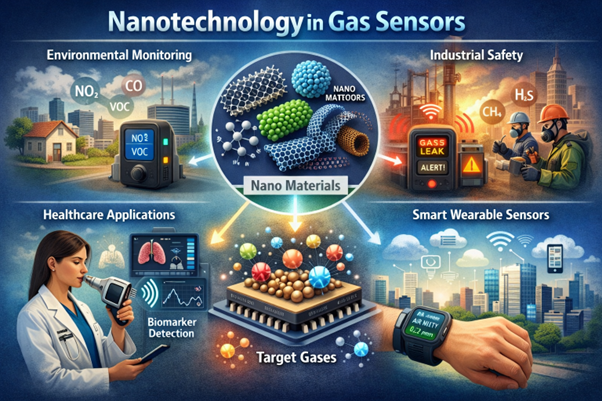
The rapid advancement of nanotechnology has significantly transformed the field of gas sensing by enabling the development of sensors with enhanced sensitivity, selectivity, and response speed. Gas sensors play a critical role in environmental monitoring, industrial safety, healthcare, and smart infrastructure. The integration of nanomaterials into gas sensor design has opened new possibilities for detecting trace-level gases and volatile compounds that were previously challenging to monitor using conventional technologies.
One of the most prominent emerging applications of nanotechnology in gas sensors is environmental monitoring. Nanostructured materials such as metal oxide nanoparticles, carbon nanotubes, and graphene exhibit large surface-to-volume ratios, providing abundant active sites for gas adsorption. This property enables highly sensitive detection of toxic and greenhouse gases, including nitrogen dioxide (NO₂), carbon monoxide (CO), ammonia (NH₃), and volatile organic compounds (VOCs). Nanotechnology-based gas sensors are increasingly deployed in air quality monitoring systems to support real-time pollution tracking and early warning mechanisms.
In industrial and occupational safety, nanotechnology has facilitated the development of compact and low-power gas sensors capable of operating under harsh conditions. Nanostructured metal oxides and hybrid nanocomposites offer improved thermal stability and rapid response, making them suitable for detecting flammable and hazardous gases in industrial environments. These sensors enhance workplace safety by enabling early detection of gas leaks and preventing potential accidents, particularly in chemical plants, mining operations, and oil and gas facilities.
Healthcare and biomedical applications represent another emerging area for nanotechnology-enabled gas sensors. Nanomaterial-based sensors are increasingly explored for breath analysis, where specific gaseous biomarkers can indicate disease conditions such as diabetes, lung cancer, and respiratory disorders. The high sensitivity and selectivity of nanostructured sensing layers allow for non-invasive and rapid diagnosis, supporting the development of portable and point-of-care diagnostic devices.
Furthermore, the integration of nanotechnology with flexible electronics and the Internet of Things (IoT) has expanded the application of gas sensors in smart systems. Flexible, wearable gas sensors incorporating nanomaterials enable continuous monitoring of environmental and personal exposure to harmful gases. When combined with wireless communication and data analytics, these sensors contribute to smart cities, smart homes, and personalized health monitoring platforms.
In conclusion, recent emerging applications of nanotechnology in gas sensors demonstrate its transformative impact across multiple sectors. By leveraging the unique properties of nanomaterials, gas sensors have achieved unprecedented levels of performance and versatility. Continued research and innovation in nanotechnology are expected to further advance gas sensing technologies, supporting safer environments, improved healthcare, and more intelligent monitoring systems in the near future.
Date of Input: 08/01/2026 | Updated: 08/01/2026 | roslina_ar
MEDIA SHARING