The iron and steel industry, a cornerstone of global development, produces a by-product that is often overlooked known as mill scale. This flaky residue forms when hot steel oxidizes during the rolling process. Traditionally treated as scrap or discarded in landfills, mill scale accumulates in massive quantities, contributing to environmental hazards such as soil contamination and heavy-metal leaching. However, recent advances in nanotechnology have transformed this industrial waste into a valuable raw material. Researchers at institute of Nanoscience and Nanotechnology (ION2), Universiti Putra Malaysia (UPM) have discovered that the iron oxides in mill scale can be recycled and converted into magnetic nanoparticles that play a crucial role in cleaning polluted water
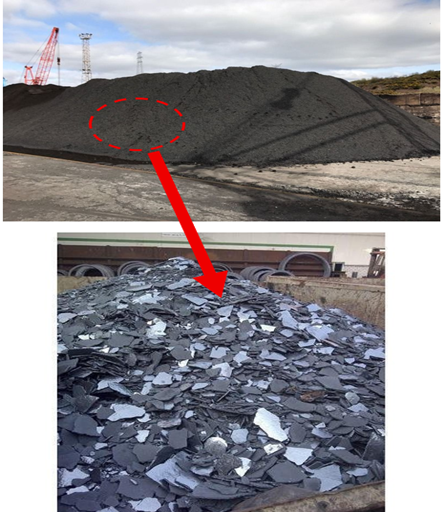
Mill scale is primarily composed of iron oxides such as magnetite (Fe₃Oâ‚„), hematite (Feâ‚‚O₃), and wüstite (FeO), together with small amounts of impurities like dust, sand, and trace metals. In steel production, water jets are used to remove this oxide layer from the metal surface, generating large amounts of sludge. Instead of allowing this residue to accumulate, scientists from Institute of Nanoscience and Nanotechnology (ION2), Universiti Putra Malaysia (UPM) have developed patented methods to recover pure magnetic iron oxides through sequential separation and processing steps. Two important purification techniques, namely magnetic separation (MST) and Curie temperature separation (CTST), enable researchers to isolate magnetic iron oxides from nonmagnetic impurities. The CTST method involves heating the sample close to the Curie temperature of wüstite, around 78 °C, where its magnetic strength diminishes, allowing it to be cleanly separated from the strongly magnetic magnetite grains. Once purified, the extracted iron oxides are further processed through high energy ball milling, a mechanical grinding process that reduces the material to nanoscale dimensions. Extended milling decreases the particle size and alters certain oxide phases, producing highly crystalline magnetite nanoparticles about 10 nanometers in diameter. These nanosized particles possess remarkable surface area and magnetic sensitivity, both of which are crucial for effective environmental remediation.
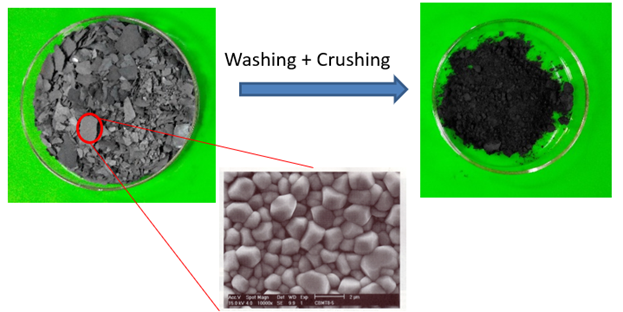
The transformation of mill scale waste into magnetite nano-adsorbents (MNA) begins with mechanical refinement and purification. The cleaned material is subjected to HEBM at speeds up to 1700 rpm for several hours. As the steel balls inside the milling vials collide with the powder, they generate localized high-energy impacts that fracture large oxide particles into smaller crystalline domains. Each collision alters the atomic structure slightly, producing ultrafine grains while maintaining magnetite’s characteristic spinel crystal lattice. After milling, the powders are characterized using advanced techniques such as X-ray diffraction (XRD), transmission electron microscopy (TEM), and vibrating sample magnetometry (VSM). The XRD patterns confirm the presence of magnetite as the dominant phase, while TEM images show nearly spherical nanoparticles ranging from 10 nm to 15 nm. The magnetic properties, though weaker than bulk magnetite due to surface effects, remain strong enough to allow external magnetic fields to retrieve the particles after water treatment. The specific surface area typically increases with milling time, providing more reactive sites for adsorption of contaminants.
 Contamination of water by heavy metals has become one of the most serious environmental challenges worldwide. Among the various pollutants, copper ions (Cu²âº) are of particular concern. While copper is vital for biological processes in small amounts, it becomes toxic at higher concentrations and can lead to liver and kidney damage, neurological disorders, and even death. Industrial operations such as mining, electroplating, and metal finishing release large amounts of wastewater containing copper. Traditional treatment approaches such as chemical precipitation, ion exchange, and membrane filtration often face limitations due to high costs and incomplete removal. In contrast, adsorption using nanomaterials provides a more efficient and straightforward solution.
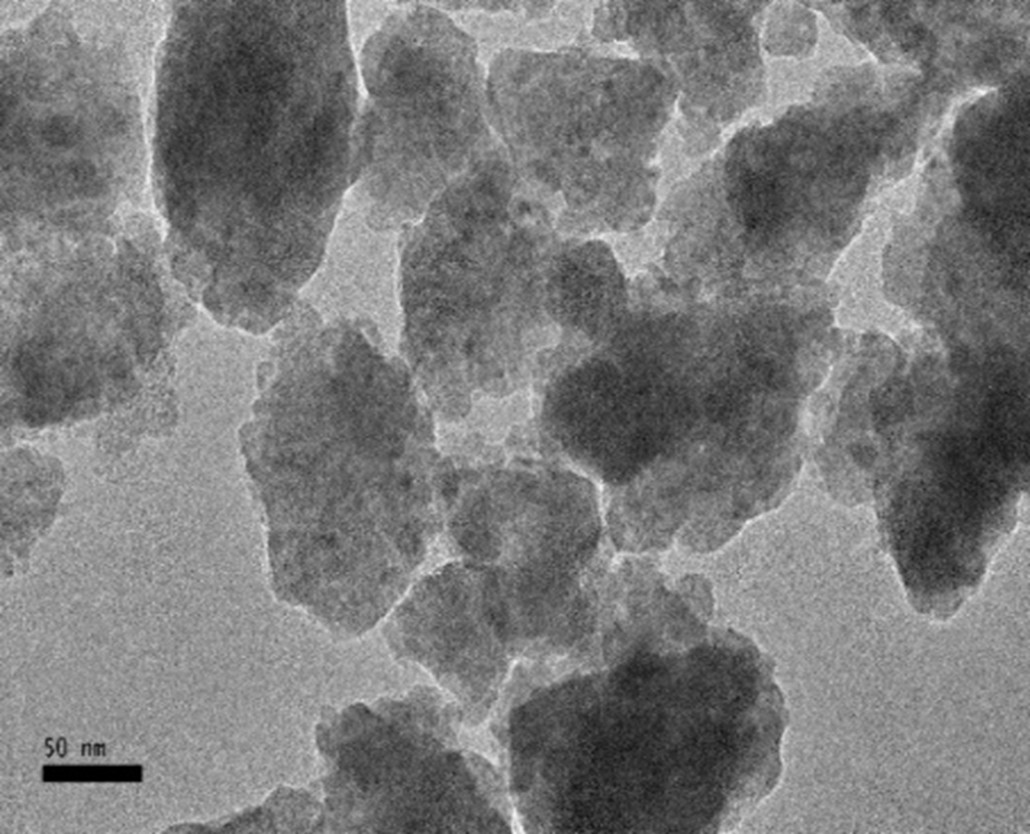
HRTEM image of iron oxide nanoparticles
Magnetite nanoparticles derived from mill scale serve as highly efficient adsorbents for removing copper ions from water. Their effectiveness arises from two main factors: the large surface area, which increases the number of active binding sites, and the magnetic property, which simplifies recovery after use. During treatment, copper ions interact with hydroxyl groups present on the nanoparticle surface through electrostatic attraction and complexation. The adsorption capacity depends on several variables such as pH, contact time, and particle dosage. Studies have shown that the optimal removal occurs around neutral pH 7, where surface charge balance favours metal uptake. In experimental tests, 1 gram of magnetite nanoparticles could adsorb up to 4.4 milligrams of copper ions within two hours of contact time. The adsorption process follows the pseudo-second-order kinetic model, indicating that chemical interactions dominate rather than simple physical adhesion. The equilibrium data fit well with the Temkin isotherm, suggesting that the heat of adsorption decreases gradually with coverage, as active sites become occupied. After treatment, the nanoparticles are magnetically separated from water and regenerated using mild acid washing, maintaining over 70 percent of their adsorption efficiency after three reuse cycles. This ability to recycle the adsorbent further strengthens its environmental and economic appeal.
At the nanometer scale, surface behaviour determines how the material performs. Magnetite nanoparticles contain both Fe²âº and Fe³âº ions arranged within a cubic spinel crystal structure. This combination of oxidation states allows strong redox interactions with dissolved metals and organic compounds. When copper ions approach the surface, they can either substitute iron ions through ion exchange or attach by forming coordination bonds with surface oxygen atoms. In slightly alkaline conditions, hydroxyl groups form on the surface, increasing the number of negatively charged sites that attract positively charged metal ions more effectively. The zeta potential, which indicates the surface charge of magnetite nano adsorbents, varies with pH and reaches neutrality near pH 5.4. Below this point, the surface carries a positive charge and repels metal cations, while above it, the surface becomes negatively charged, improving adsorption efficiency. The roughness and porosity at this small scale enhance the movement of water molecules and ions, allowing rapid diffusion across the surface. As a result, these nanoparticles trap and hold metal contaminants much faster than traditional adsorbents such as activated carbon or clay.
Although pure magnetite is very reactive, its tiny particles tend to clump together because of magnetic attraction and van der Waals forces. To overcome this issue, researchers use surface modification with surfactants such as cetyltrimethylammonium bromide (CTAB). The CTAB molecules form a thin protective layer around each nanoparticle, acting as a barrier that prevents aggregation while keeping the particles well dispersed in water. These modified nanoparticles show a larger effective surface area and retain stable magnetic behaviour during multiple reuse cycles. Even though the overall magnetization becomes slightly lower after coating, the enhanced dispersion improves adsorption efficiency by promoting better contact with pollutants. In addition, such surface treatments can introduce functional chemical groups like amines, carboxyls, or thiols, which can selectively capture specific metals or organic compounds. This approach makes it possible to design specialized adsorbents capable of removing not only copper but also other toxic metals such as lead, chromium, and arsenic from industrial wastewater. The combination of precise particle synthesis and carefully engineered surface chemistry offers a versatile strategy for tackling a wide range of environmental problems.
A significant advantage of magnetic nano-adsorbents is their reusability. After adsorption, the loaded particles are separated using an external magnet, washed with a dilute acid to desorb the captured metals, and reused in subsequent treatment cycles. Studies demonstrate that after three cycles of regeneration, the magnetite nanoparticles maintain more than two-thirds of their original adsorption capacity. This reusability not only reduces material costs but also minimizes secondary waste generation. The recovered copper can be further processed, contributing to circular economy practices where industrial residues and pollutants become valuable feedstocks rather than disposal burdens.
From an energy standpoint, the entire recycling process, starting from the collection of mill scale to the synthesis of nanoparticles, is relatively inexpensive. The mechanical milling technique operates without the need for complex chemical reactions or extremely high temperatures, which makes it suitable for use in developing regions that face difficulties in managing industrial waste. The straightforward nature of the magnetic separation process, together with the ease of recovering nanoparticles using magnetic fields, provides clear advantages for expanding this technology to large-scale industrial wastewater treatment facilities.
 Visualization of wastewater treatment using iron oxide nanoparticles produced from mill scale waste with varying particle sizes: a) untreated palm oil mill effluent (POME), b) nanoparticles after 4 hours of milling, c) nanoparticles after 6 hours of milling, d) nanoparticles after 9 hours of milling, and e) nanoparticles after 12 hours of milling.
Transforming mill scale waste into nano-adsorbents illustrates how green chemistry principles can align industrial processes with environmental protection. The steel industry, which produces millions of tons of mill scale annually, could redirect a portion of this waste toward environmental remediation. By integrating waste recycling into wastewater treatment systems, industries can close material loops and reduce their ecological footprint. Furthermore, the approach provides dual benefits: reducing solid waste from steel manufacturing and mitigating water pollution from heavy-metal discharge. The resulting magnetite nanoparticles also hold promise beyond water purification. Due to their magnetic and catalytic properties, they can serve as precursors for sensors, pigments, and biomedical agents for targeted drug delivery or magnetic resonance imaging. Such multifunctional potential underscores the role of nanotechnology as a bridge between waste management and high-value applications.
While laboratory experiments have demonstrated the feasibility and efficiency of magnetite nano-adsorbents, future work must focus on scaling the process sustainably. Key challenges include ensuring consistent particle quality during large-scale production, optimizing regeneration cycles, and evaluating long-term stability in complex wastewater systems that contain multiple ions and organic substances. Collaboration between research institutions and steel industries can accelerate technology transfer, turning mill scale from a liability into a marketable resource. Moreover, integrating this technology with existing wastewater infrastructure could enable hybrid systems where magnetic adsorbents complement biological or membrane processes. Continuous-flow reactors with magnetic recovery mechanisms could provide a steady and automated solution for treating industrial effluents.
The transformation of mill scale from a by-product of hot-rolled steel into a nanomaterial capable of purifying polluted water stands as a remarkable example of circular innovation. It illustrates how scientific creativity can convert waste materials into practical solutions for global environmental challenges. Each nanoparticle, once a fragment of an oxidized steel surface, now acts as a tiny protector that captures harmful metals and helps return water to a cleaner state. As modern societies confront the combined challenges of increasing waste and environmental pollution, innovations like this represent a major shift in thinking. They show that true sustainability depends not only on reducing production but also on reimagining how materials are used and reused throughout their entire life cycle. With ongoing research and careful implementation, converting mill scale waste into magnetite nanoparticles has the potential to become a foundation for future green industries, where chemistry, engineering, and environmental responsibility work together to benefit both humanity and the Earth.
Written by:
Dr. Ismayadi Ismail (ION2, UPM)
Date of Input: 23/12/2025 | Updated: 23/12/2025 | roslina_ar
MEDIA SHARING