Developing sustainable active food packaging is a critical priority for addressing the environmental impact of fossil-fuel-derived plastics while extending the shelf life of perishable food products. In a 2025 study published in the Journal of Science: Advanced Materials and Devices, researchers developed and characterized novel active packaging films by blending cassava starch with varying concentrations (1, 2, 3, and 4 %w/v) of carbon black nanoparticles (CBN). While starch is a widely available and biodegradable natural biopolymer, it typically suffers from poor mechanical, thermal, and barrier properties. This research aimed to overcome these limitations by utilizing the high surface area and multifunctional potential of low-cost CBN to create superior starch-based nanocomposite films.
The films were fabricated using a solvent-casting method and subjected to rigorous testing to evaluate their morphological, physical, mechanical, thermal, and barrier attributes. The results revealed that the inclusion of CBN significantly enhanced the structural integrity of the starch matrix. Specifically, tensile strength (TS) improved as CBN particles filled empty spaces within the matrix and formed strong hydrogen bonds, resulting in films with a TS range of 12.36–24.38 MPa. While this increased strength led to a reduction in elongation at break (EAB), making the films less ductile, the overall mechanical properties remained comparable to common food plastics like low-density polyethylene (LDPE).
Beyond mechanical reinforcement, the starch/CBN films demonstrated exceptional functional properties suitable for active packaging. The incorporation of even 1 %w/v CBN allowed the films to block approximately 45% of ultraviolet-C (UV-C) light, a feature that helps prevent photooxidation and nutrient degradation in light-sensitive foods. Furthermore, the films exhibited strong antibacterial activity against both gram-positive (S. aureus) and gram-negative (E. coli) bacteria. The study found that a 2 %w/v concentration of CBN was sufficient to effectively inhibit these common foodborne pathogens. Thermal stability and barrier properties, including water vapor permeability (WVP) and oxygen transmission rate (OTR), were also notably enhanced by the addition of CBN.
The practical effectiveness of these films was validated through a case study using cherry tomatoes. The researchers observed that tomatoes packaged with starch/CBN films, particularly those with a 2 %w/v concentration, showed the best preservation results. These tomatoes experienced the least mold growth and the lowest percentage reduction in both firmness and weight compared to those in neat starch packaging. This optimal performance was attributed to the balanced WVP and oxygen permeability of the 2 %w/v films, which maintained necessary respiration while preventing the high-humidity or anaerobic environments that lead to decay.
In conclusion, the study successfully demonstrated that cassava starch films reinforced with carbon black nanoparticles offer a viable, sustainable alternative for advanced food packaging. The starch/CBN (2 %w/v) film emerged as the most effective formulation for maintaining food quality and extending shelf life. These findings suggest that carbon-based nanocomposites can significantly improve the performance of natural biopolymers, contributing to the development of greener technologies in the agri-food industry.
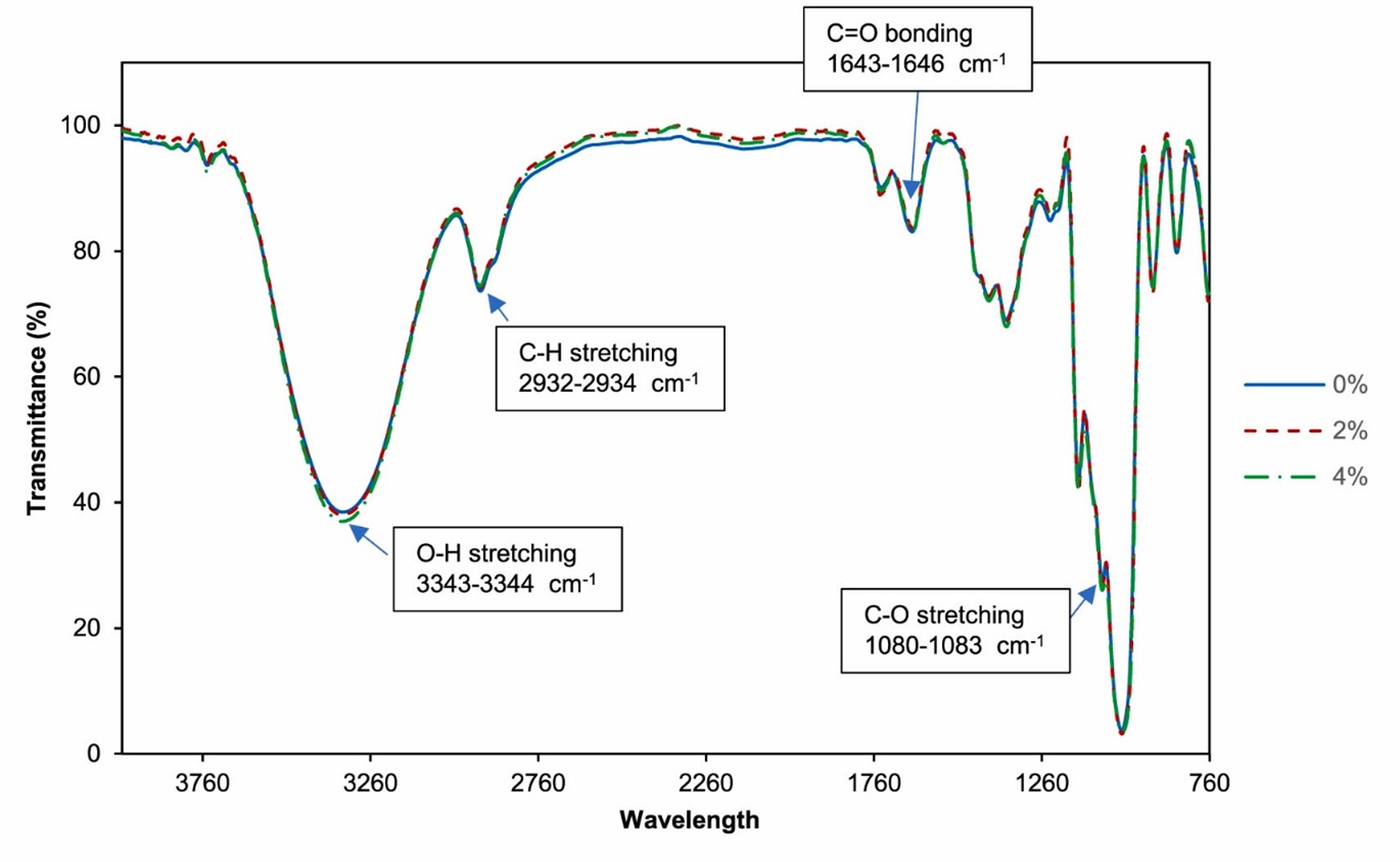
Figure 1: FTIR spectra of the neat starch and starch/CBN (2, 4 %w/v) films.
 Figure 2: Appearance of the (a) neat starch, (b) starch/CBN (1 %w/v), (c) starch/CBN (2 %w/v), (d) starch/CBN (3 %w/v), and (e) starch/CBN (4 %w/v) films.
Source:
Siti Hajar Othman*, Nur Syahira Zaid, Ruzanna Ahmad Shapi'i, Norhazirah Nordin, Rosnita A Talib, Intan Syafinaz Mohamed Amin Tawakkal
(https://doi.org/10.1016/j.jsamd.2025.100995)
Prepared by,
Ts. Dr. Mohd Hafizuddin Ab Ghani
Date of Input: 09/02/2026 | Updated: 09/02/2026 | roslina_ar
MEDIA SHARING