When engineers drill kilometers into the earth to access subterranean energy resources, they rely heavily on a specialized fluid known in the industry as drilling mud. This fluid functions as the literal bloodstream of any deep wellbore operation. It constantly circulates down the lengthy metal drill pipe to cool and lubricate the spinning bit, flushes crushed rock cuttings back up to the surface, and lines the freshly carved borehole walls with a protective cake layer to prevent underground collapse.
For decades, the petroleum exploration sector depended on petroleum-based oil muds because they withstand harsh subterranean conditions remarkably well. However, conventional mineral oil fluids present serious environmental challenges whenever spills occur or when drill cuttings must be disposed of safely. To protect fragile marine and terrestrial ecosystems, scientists have engineered synthetic ester-based drilling fluids derived from natural plant sources. These eco-friendly ester fluids biodegrade naturally in the environment, making them a much cleaner and greener alternative for modern energy exploration.
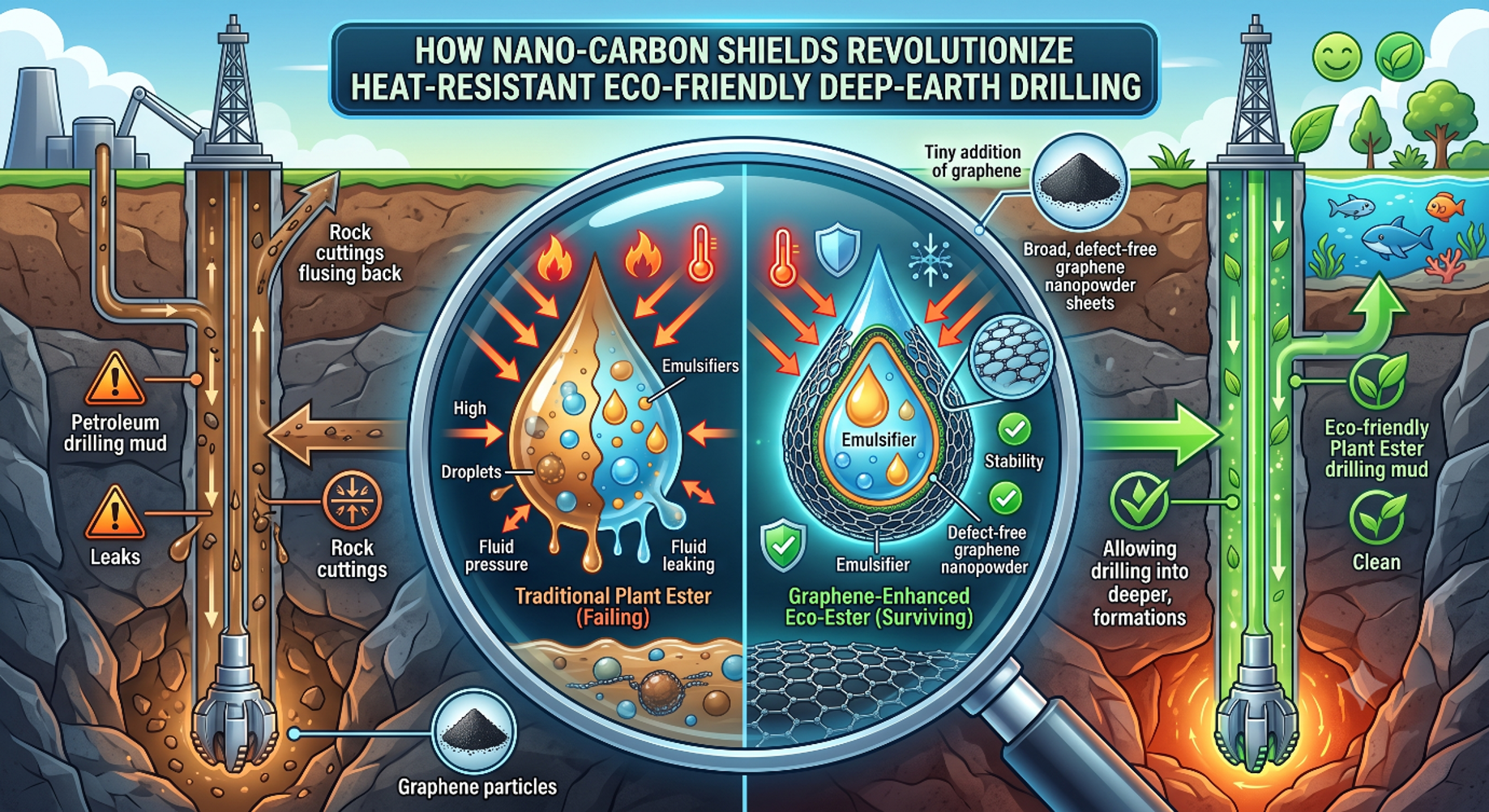
Despite their clear environmental benefits, traditional plant-based ester fluids possess a challenging engineering limitation. As drill bits plunge deeper into the earth's crust, they encounter brutal subterranean environments known as high-pressure high-temperature conditions. At temperatures surpassing one hundred and fifty degrees Celsius and under immense physical pressures, standard plant esters begin to break down chemically. They lose their viscosity, undergo rapid chemical hydrolysis, and fail to keep their internal water and oil components stably blended together.
To overcome this thermal barrier, a collaborative scientific research team led by Dr. Siti Zulaika Razali and Robiah Yunus from Universiti Putra Malaysia, formulated an advanced base fluid called 2-ethylhexyl ester. While this newly synthesized ester survives extreme freezing cold and scorching deep-well heat far better than older formulations, the researchers sought to push its mechanical and thermal performance even further by introducing microscopic carbon nanomaterial additives.
Nanotechnology involves manipulating matter at an atomic scale where fascinating physical and chemical behaviors emerge. The Malaysian research team investigated five distinct carbon nanomaterials to discover which structure could best reinforce their eco-friendly drilling fluid. The evaluated contenders included pure graphene nanopowder, commercial graphene nanoplatelets, in-house synthesized graphene nanoplatelets, graphene oxide, and fibrous carbon nanotube cotton.
Graphene consists of a single layer of carbon atoms tightly bound in a flat honeycomb lattice, while carbon nanotubes resemble microscopic hollow threads spun from identical carbon lattices. The scientists paid careful attention to two critical atomic characteristics of these microscopic particles: their physical morphology, which refers to their exact structural shape and physical dimensions, and their degree of graphitization, which measures the structural perfection and crystalline purity of the carbon lattice.
To simulate the hostile environment inside a working drilling wellbore, the researchers blended tiny concentrations of each carbon nanomaterial into their ester drilling fluid and sealed the samples inside a specialized laboratory apparatus called a hot roller oven. The experimental fluids were continuously tumbled and baked at a scorching one hundred and eighty-two degrees Celsius for sixteen consecutive hours.
Following this rigorous thermal ordeal, the team subjected the baked fluids to high-pressure filtration tests pushed to five hundred pounds per square inch. In a working wellbore, fluid loss occurs when the liquid portion of the mud leaks into porous surrounding rocks, leaving behind a solid mineral residue called a filter cake along the rock walls. If a fluid leaks excessively, the deposited filter cake grows rapidly thick, which can mechanically seize drilling pipes and halt multi-million-dollar operations entirely. Therefore, an ideal nanomaterial additive must maintain liquid emulsion stability, prevent fluid leakage into rock formations, and deposit a remarkably thin, impenetrable cake wall.
When the comprehensive laboratory evaluations were completed, pure graphene nanopowder emerged as the undisputed scientific champion. While other carbon structures struggled under intense heat or caused the mud to become unmanageably thick, graphene nanopowder dramatically improved the fluid across every measured engineering metric. The secret to its remarkable success lies in its broad lateral sheet size, its near-perfect crystalline carbon structure containing very few structural defects, and its intensely hydrophobic nature.
Because graphene nanopowder strongly repels water molecules, it migrated directly to the microscopic interfaces separating tiny water droplets from the surrounding ester oil. At that interface, the wide carbon sheets anchored themselves securely to the chemical emulsifiers already present in the mud, wrapping a tough protective armor around the liquid droplets. This microscopic double-layer shield successfully prevented the chemical emulsifiers from degrading under the intense 182 oC heat, keeping the drilling fluid perfectly blended and stable.
Beyond stabilizing the fluid mixture against extreme temperatures, graphene nanopowder demonstrated extraordinary sealing capabilities during high-pressure filtration tests. At an exceedingly low concentration of just 0.007 percent by weight, the nanopowder reduced liquid leakage into surrounding porous rocks by twenty percent compared to fluids lacking carbon additives.
Furthermore, high-resolution electron microscope images revealed that the flat graphene sheets acted as flexible structural bridges, wrapping around heavy mineral particles in the mud and binding them together tightly along the test surfaces. This efficient packing mechanism reduced the thickness of the deposited filter cake wall by nearly twenty-five percent. Maintaining a thin, tough filter wall preserves wide clearance inside the borehole and prevents heavy drilling equipment from getting stuck deep underground. In stark contrast, oxidized graphene performed poorly because its water-attracting oxygen groups disrupted the oil emulsion entirely, proving that structural crystalline perfection is vital for high-temperature success.
This pioneering research conducted at Universiti Putra Malaysia highlights how deliberate modifications at the nanoscale can resolve massive industrial engineering challenges. By demonstrating that the morphology and crystalline perfection of carbon additives directly govern fluid behavior under subterranean stress, the scientific team has established a clear pathway to upgrade biodegradable drilling fluids.
Adding just a microscopic fraction of pure graphene nanopowder empowers plant-derived ester fluids to perform reliably in deep, hot drilling operations where only polluting petroleum muds could previously survive. As global resource exploration demands higher operational efficiency alongside stricter environmental preservation, this Malaysian materials research provides a shining example of how clean chemistry and advanced nanotechnology can move forward together.
Source: https://www.sciencedirect.com/science/article/pii/S2238785422015447?via%3Dihub
Prepared by: Dr. Ismayadi Ismail (NSCL)
Date of Input: 24/08/2026 | Updated: 24/08/2026 | roslina_ar
MEDIA SHARING