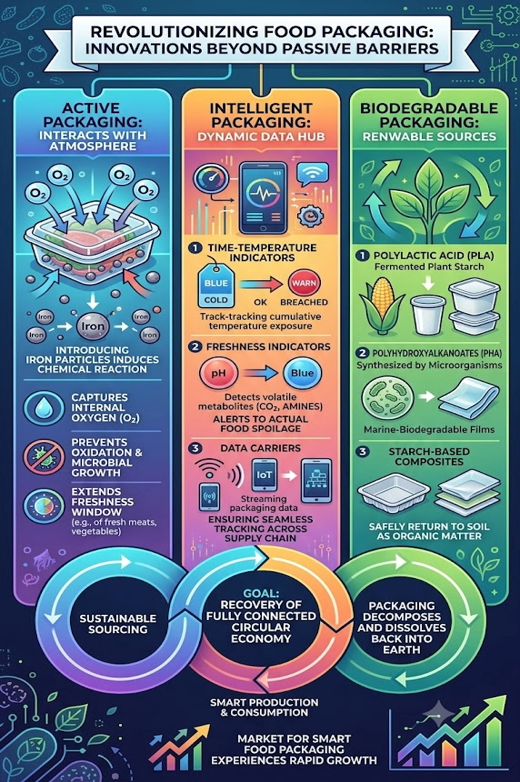
Food packaging is undergoing a profound transformation, moving far beyond traditional passive barriers that simply separate food from the outside environment. Today’s innovations are actively revolutionizing how we preserve, track, and dispose of packaging materials. This shift is driven by the rapid growth of smart food packaging, which seamlessly integrates active, intelligent, and eco-friendly technologies to enhance both consumer safety and global sustainability.
At the forefront of this revolution is active packaging, which is uniquely designed to interact directly with the internal atmosphere of the container. By introducing iron particles into the materials, these systems induce a chemical reaction that captures internal oxygen (O2). This proactive mechanism successfully prevents oxidation and microbial growth, significantly extending the freshness window of perishable goods like fresh meats and vegetables.
Complementing this preservation is intelligent packaging, which serves as a dynamic data hub for consumers and supply chains alike. It utilizes time-temperature indicators to visually warn against cold-chain breaches, alongside pH-sensitive freshness indicators that change color to alert users of actual food spoilage based on volatile metabolites. Furthermore, embedded data carriers using IoT and NFC technologies stream real-time information, ensuring seamless tracking from farm to table.
To combat the mounting environmental burden of conventional plastics, the industry is increasingly embracing biodegradable packaging derived from renewable sources. Materials like Polylactic Acid (PLA) made from fermented plant starch and microorganism-synthesized Polyhydroxyalkanoates (PHA) offer robust, marine-biodegradable alternatives. Alongside starch-based composites, these innovations allow packaging to safely dissolve and return to the earth as organic matter.
The ultimate goal of synergizing these three technologies is to forge a fully connected circular economy. This sustainable loop champions everything from the responsible sourcing of renewable materials to smart consumption and natural decomposition. As these breakthroughs continue to evolve, they promise a future where food packaging is as brilliant as it is sustainable.
Prepared by,
Ts. Dr. Mohd Hafizuddin bin Ab Ghani
Research Officer (NPTL)
Date of Input: 26/08/2026 | Updated: 26/08/2026 | roslina_ar
MEDIA SHARING